Best Instagram Posting Times in 2026 (Data-Backed)
June 13, 2026 · Naman Patel

Everyone wants the magic number.
So let’s get the honest part out of the way first: the single best time to post on Instagram is whenever your audience is actually awake and scrolling. That’s not a cop-out — it’s the whole game.
But here’s the thing. Most people don’t know when their audience is scrolling, and even if they did, there’s enough overlap in human behaviour that general patterns genuinely help. So in this article, we’re going to do both — give you the data-backed starting points, and explain why those numbers exist in the first place.
Why Timing Even Matters in 2026
Here’s something most people don’t realise about how Instagram actually works.
Every time you post, Instagram doesn’t immediately blast it to all your followers. Instead, it shows your post to a small test group first. If that group engages quickly — within the first 30 to 60 minutes — Instagram takes that as a signal worth amplifying, and pushes your post wider, into Explore, Reels feeds, and beyond.
Instagram’s own Head of Instagram, Adam Mosseri, has described this publicly as something close to an “audition” system — your content gets an initial tryout in front of a small audience, and how that group reacts determines how far it travels next.
So if you post when your audience is asleep, you fail the audition before anyone good ever sees it. It doesn’t matter how good your content is. There’s simply no one in the room to clap.
That’s why timing isn’t some vanity metric obsession. It’s the difference between a post that snowballs and one that quietly dies with 12 likes.
What the Latest Data Actually Says
If you just want the numbers without the explanations, here’s everything from above in one place.
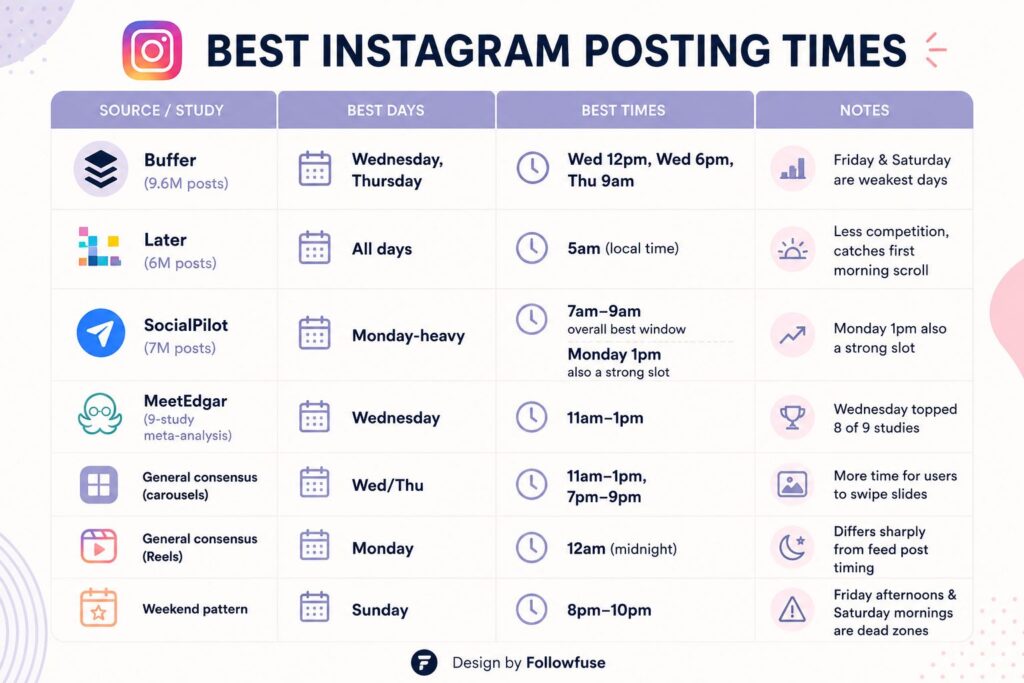
The pattern that holds up across almost every study: Wednesday and Thursday are your safest bets, the 11am-1pm and 6pm-9pm windows show up repeatedly, and early mornings (5am-9am) are a legitimate alternative if you want less competition in the feed.
Okay, time for the numbers. We pulled from several major 2026 studies — and while the exact hours differ slightly between them (because every dataset samples a different mix of accounts and audiences), the overall pattern is remarkably consistent.
Mid-week is king!
Across nearly every major study, Wednesday and Thursday consistently outperform every other day of the week. A MeetEdgar meta-analysis combining nine separate studies found Wednesday came out on top in eight of them.
Within those days, two windows show up again and again:
- The lunch scroll: 11am–1pm. People are on a break, phones come out, thumbs start moving.
- The evening wind-down: 6pm–9pm. Work is done, dinner’s either happening or just happened, and Instagram becomes the default “let’s see what’s going on” app.
Buffer’s State of Social Engagement 2026 report, which analysed 9.6 million Instagram posts across 200,000+ accounts, pinned the three strongest individual slots as Wednesday at 12pm, Wednesday at 6pm, and Thursday at 9am — which lines up almost perfectly with the lunch-and-wind-down pattern.
The early morning surprise
Here’s where it gets interesting. Later’s 2026 analysis of over 6 million posts found that content posted around 5am in the audience’s local time zone consistently saw higher-than-average engagement — across every single day of the week.
The theory makes sense when you think about it. A chunk of people genuinely do check their phones first thing — before work, while having coffee, during that weird half-awake scroll. If you post at 5am, you’re catching that first wave with almost zero competition, since most accounts are posting on a 9-to-5 schedule like everyone else.
Another study, this one from SocialPilot, analysed 7 million posts from roughly 50,000 accounts and landed on a similar early window — finding the overall best time to post sits between 7am and 9am.
So you’ve essentially got two competing “best times” depending on which study you read: the early morning quiet-hours window, and the midday-to-evening high-traffic window. Both work — they just work for different reasons. Early morning wins on low competition. Midday and evening win on raw audience size.
Also read: 9 Best Instagram Growth Services in 2026
Weekends are a different beast entirely
If there’s one thing almost every study agrees on, it’s this: Friday and Saturday are rough days to post.
Friday afternoons in particular tend to underperform — people are mentally checked out and heading into weekend mode, which doesn’t exactly scream “let me stop and comment on this carousel.” Saturday mornings are even quieter; most people are sleeping in, and Instagram engagement hits its weekly low.
Sunday is a bit more forgiving, especially in the evening. As the weekend winds down and people start mentally preparing for Monday, engagement around 8pm–10pm on Sunday tends to pick back up — making it a decent slot for lighter, lower-stakes content like Stories, polls, or casual Reels.
It also depends on what you’re posting
Timing isn’t one-size-fits-all across content types either.
Reels tend to follow slightly different rules than static feed posts — one major study found Reels posted at midnight on Mondays saw the strongest engagement, which is a great example of why blanket advice only gets you so far.
Carousels, on the other hand, do particularly well during the lunch window (11am–1pm) and again in the evening (7pm–9pm) — likely because people actually have a moment to sit and swipe through multiple slides, rather than scroll past in half a second.
What Popular Creators and Marketers Actually Say
Beyond the big data studies, there’s a consistent theme running through how working creators and social media managers talk about this — and it’s less about chasing exact hours and more about understanding why those hours work.
Marketing teams at companies like Buffer and Later, who run these large-scale studies every year, repeatedly come back to the same caveat: the numbers are a starting point, not a destination. Buffer’s own research notes that their data reflects median engagement across hundreds of thousands of accounts — useful for spotting general patterns, but not a substitute for knowing your specific audience.
This is echoed constantly in creator communities and marketing podcasts, where the recurring advice is some version of: check your own Instagram Insights before trusting any blog post — including this one. Your audience’s time zone, age group, and daily habits will always beat a generic benchmark, because a generic benchmark is, by definition, an average of millions of people who aren’t your followers.
The other theme that comes up constantly: consistency beats precision. Posting at a “good enough” time every single day, on a predictable schedule, tends to outperform someone who occasionally nails the “perfect” slot but posts erratically. Instagram — and your followers — both reward rhythm.
So… What Should You Actually Do?
Here’s a simple way to think about it.
If you’re just starting out and have no audience data yet, use the research as your launchpad:
- Post Wednesday or Thursday if you can
- Try the 11am–1pm window for carousels and feed posts
- Try 6pm–9pm for general content and Reels
- If you’re a night owl or your audience skews to early risers, test the 5am–9am window too — less competition can work in your favour
If you already have an audience, your own data will always beat any study. Instagram’s built-in Insights (under your Professional Dashboard) will show you exactly when your followers are online — and that’s worth more than any blog post, including this one.
Either way, treat these numbers as a hypothesis, not a rulebook. Post, track engagement for a few weeks, adjust, repeat.
Also read: 7 AI Instagram Growth Tools (Tested & Ranked)
FAQ: Best Instagram Posting Times
How do I see my best posting times on Instagram?
Open your Professional Dashboard (available for Creator and Business accounts), then head to Insights. From there, look at “Total followers” and tap into the activity breakdown — Instagram shows you a chart of when your followers are most active, broken down by day and hour. This is personalized to your actual audience, which makes it far more useful than any general study. If you’re using a scheduling tool like Buffer, Later, or Hootsuite, most of these also have a “Best Time to Post” feature that analyses your account’s historical performance automatically.
Should you post at the same time every day on Instagram?
Mostly, yes — but with some flexibility. Consistency helps both your audience (they start to expect your content at a certain point in their day) and the algorithm, which tends to reward predictable, steady activity over erratic bursts. That said, you don’t need to be robotic about it. Posting within the same general window — say, somewhere between 11am and 1pm — works just as well as hitting the exact same minute every day. The goal is rhythm, not precision to the second.
Is it better to post on Instagram in the morning or evening?
Both have a case, and the right answer depends on your audience and content type. Mornings (especially the 5am–9am window) tend to have less competition, since fewer accounts post that early — meaning your content has a better shot at standing out in a quieter feed. Evenings (6pm–9pm) have more competition, but a much larger pool of people actively scrolling after work or dinner. If your content is more “stop and think” style (carousels, educational posts), evenings often perform well since people have more time. If you’re testing for reach with less noise, mornings are worth a shot. Honestly, the best approach is to try both for a couple of weeks and compare your engagement rate, not just raw likes.
Can you set Instagram to post at a certain time automatically?
Yes. Instagram has a native scheduling feature built into Creator and Business accounts — when creating a post in the app, you can choose to schedule it for a future date and time instead of posting immediately. You can also schedule directly through Meta Business Suite on desktop, which tends to be more reliable for planning content in bulk. Third-party tools like Later, Buffer, and Hootsuite also offer scheduling, often with the added bonus of analytics and “best time to post” suggestions baked in — useful if you’re managing multiple accounts or want everything in one calendar view.
Wrapping It Up
If you take one thing away from all of this, let it be this: timing helps you get heard, but it’s not what makes people listen.
The studies agree that Wednesday and Thursday, the lunch window, and the evening wind-down are solid bets for most accounts. The early morning slot is a legitimate alternative if you want less competition. Weekends, especially Friday afternoons and Saturday mornings, are generally quieter across the board.
But none of that matters if the content itself doesn’t give people a reason to stop scrolling. Use the research as your starting line, check your own Insights once you have enough data, stay consistent, and let your actual numbers — not a blog post — become your real guide over time.